A Berachain wallet is any Ethereum-style wallet that can hold and send BERA, Berachain's native coin, along with tokens such as BUSD. Your address is the same 0x address you use on Ethereum, and every transaction pays its fee in BERA. Blocks arrive about every two seconds and are final as soon as they land.
If you read about Berachain in 2025, update your notes. The chain's proof of liquidity system was rebuilt in mid-2026. BGT, the old reward token, was retired on July 8, 2026, and the HONEY stablecoin became BUSD on August 19, 2026. This guide covers the network as it works in October 2026.
Berachain at a glance#
Item | Berachain |
|---|---|
Native coin | BERA, used for gas and staking (18 decimals) |
Address format |
|
Chain ID | 80094 |
Typical fee | Under 0.001 BERA for a BERA transfer, around a hundredth of a cent |
Blocks | About 2 seconds, with single-slot finality |
Token standard | ERC-20 |
Stablecoin | BUSD (Bera USD, formerly HONEY) |
Staking | sWBERA through the Bera Hub, 7-day unbonding |
Explorer | |
In Keylo | Send, receive, ERC-20 tokens (BUSD added by contract), speed-up, swap and bridge through LI.FI, the Bepolia testnet and Activity for sends made in Keylo, but no staking, dapp connections or NFT view |
How a Berachain wallet works#
Berachain pairs a standard Ethereum execution client with BeaconKit, a consensus layer built on CometBFT. To your wallet it looks like any EVM network, so the same key and address rules apply.
Your Berachain wallet address#
Your Berachain wallet address is a regular 0x address. Because it comes from the same key, it matches the address you see on Ethereum, Arbitrum or Base. Keylo derives it on m/44'/60'/0'/0/0, the standard path MetaMask uses for its first account, so all your EVM networks share it.
What differs is the balance. BERA at your address on Berachain doesn't show up anywhere else. You won't find an activation step, a memo or a minimum balance either, so the address can receive straight away.
BERA, BUSD and what happened to BGT#
BERA pays for every transaction, and Berachain's docs say those fees are burned. Validators stake BERA to join the active set, the top 69 by stake, and new BERA is emitted as wrapped BERA (WBERA) at about 5% a year.
BGT used to be the heart of proof of liquidity. You couldn't buy or transfer it, only earn it by supplying liquidity to reward vaults. Berachain deprecated it on July 8, 2026, the day of its Fusaka hard fork. BGT no longer affects rewards or governance, and Berachain's docs point holders to the Bera Hub to redeem leftover BGT for BERA. No deadline is listed, but there's no reason to wait.
BUSD, short for Bera USD, is Berachain's dollar stablecoin. It was called HONEY until August 19, 2026, when the name and symbol changed. The contract stayed the same, so HONEY balances simply became BUSD with no swap or claim. Some wallets and explorers may show the old name for a while.
How to choose a Berachain wallet#
Any EVM wallet can be a Berachain wallet, so pick based on what you plan to do.
Extension wallets. MetaMask and Rabby run in your browser and work with Berachain once you add it. They connect to the Bera Hub, BEX and lending apps, which is where staking and liquidity happen.
Hardware wallets. A Ledger or similar device keeps the key offline and signs through one of those extensions. It suits savings you rarely touch.
Exchange accounts. Binance, Coinbase, Kraken, OKX and others list BERA. They're fine for buying, but they hold the keys.
Web wallets. Keylo works in a browser tab, with no extension to install.
A good Berachain wallet already knows chain ID 80094 and shows token contracts, not just names. With BUSD's rename, and an unrelated older coin called BUSD on other chains, the contract address is the only reliable label.
Keylo fits people who want to hold BERA and BUSD, send them and swap or bridge with the same phrase they use elsewhere. It doesn't fit proof of liquidity farming or staking, because those happen in apps Keylo can't connect to.
Adding Berachain to MetaMask or another wallet app#
Berachain's docs say any EVM wallet that supports custom networks works with the chain, and they name MetaMask, Rabby, Coinbase Wallet and Zerion among the examples. In MetaMask, open the network list, choose Add network, then Add network manually, and enter the values from Berachain's connection guide: RPC URL https://rpc.berachain.com/, chain ID 80094, currency symbol BERA and explorer https://berascan.com. Any other wallet app that accepts a custom network takes the same values. Copy them from that page, not from a reply or an ad.
How to create a Berachain wallet in Keylo#
Keylo already lists Berachain, so there's no RPC to paste and no network to add.
Open the sign-up page. Enter your full name, email, phone number and a password twice, tick the terms box and tap Create account.
When "Check your inbox" appears, confirm your email.
Under "Set up your wallet", tap Create a new wallet. The browser generates 12 words and encrypts them with a key from your password, using Argon2id and AES-256-GCM. Keylo's server only ever stores the locked copy.
Tap Berachain in your asset list to see your BERA balance and
0xaddress.Back up the words: Settings, Recovery phrase, your password, then copy them onto paper and confirm the ones Keylo asks for.
Turn on Two-factor authentication and add an Anti-phishing code in the same menu.
Do the backup before any BERA arrives. A password reset can't decrypt the wallet, and nobody at Keylo can restore it for you, so those 12 words are your only spare key.
Importing from MetaMask or Rabby#
Tap Import a recovery phrase and type your 12 or 24 words. Keylo uses the default EVM path, so your first MetaMask or Rabby account appears with its Berachain balance. Extra accounts from those apps won't show, but they keep their funds.
Practice on Berachain Bepolia#
Switch on Testnet mode under Settings, Networks, and Berachain Bepolia (chain ID 80069) appears next to mainnet. Get free test BERA from the faucet on the Bepolia Hub. Test coins have no value, so treat anyone selling them as a scammer.
Get your Berachain address now
Sign up with an email and password. Keylo generates the wallet in your browser and gives you one 0x address for Berachain and every other EVM network.
How to receive BERA and BUSD#
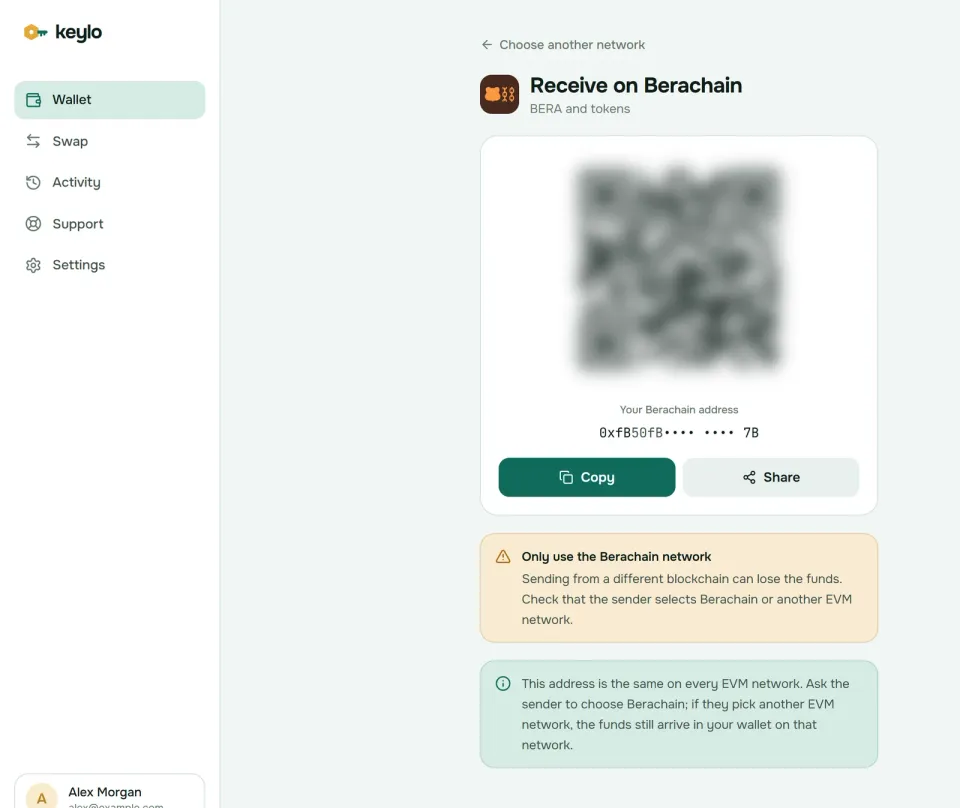
Tap Receive and pick Berachain. You'll see "Receive on Berachain", a QR code and "Your Berachain address".
Copy or share the address, or show the code to the sender.
When withdrawing BERA from an exchange, choose the Berachain network.
Check your BERA balance. With two-second blocks, a deposit usually lands within seconds of leaving the sender. On Berachain, Keylo's Activity shows only transfers you sent from Keylo, so Berascan is where incoming ones appear.
Keylo doesn't pick up BUSD on its own here. Add it once under Settings, Networks, Custom tokens with contract 0xFCBD14DC51f0A4d49d5E53C2E0950e0bC26d0Dce, symbol BUSD and 18 decimals, and the balance appears next to BERA. Keylo does check a short built-in list of common tokens, such as bridged USDC (USDC.e).
The same address works on every EVM network, and Keylo's Receive screen says so. If someone sends on Ethereum or Arbitrum by mistake, the funds wait at your address on that chain. Open that network in Keylo to find them, then bridge them across.
How to send BERA and Berachain tokens#
Tap Send, then BERA or a token on Berachain.
Fill in To by pasting or scanning. Keylo rejects addresses with a bad checksum or the wrong format.
Enter an amount. Max sends all your BERA minus the fee.
Tap Review and choose Normal, Fast or Slow. Each shows its cost.
Check the network, recipient and fee on the review screen.
Tap Send. Your browser signs the transaction, and you'll see "On its way", then "Sent", with a Berascan link.
What Keylo catches#
Keylo test-runs each transfer, so a transaction that would revert stops before you pay gas for it. It warns when the recipient is a smart contract, because tokens sent to a contract that can't handle them usually stay stuck. It also refuses to send a token to that token's own contract, a common paste error.
If a Berachain transfer ever sits pending, Speed up on the done screen resends it with a higher fee.
Berachain gas fees#
Berachain uses Ethereum's fee model: a base fee that follows demand plus a tip, both paid in BERA.
They're very low, and on Berachain the tip is most of the bill. On October 24, 2026, the base fee sat near 1 gwei, while the network's suggested tip moved between about 23 and 35 gwei. A plain BERA transfer uses 21,000 gas, so it cost roughly 0.0005 to 0.0008 BERA. With BERA near $0.15, that's around a hundredth of a cent. Token transfers and swaps use more gas but stay cheap.
Keylo's Slow, Normal and Fast levels scale that suggested tip, so the gap between them here is mostly tip, and each level shows its cost before you choose. Keylo adds nothing to a normal send.
Proof of liquidity in 2026: sWBERA and reward vaults#
Proof of liquidity still exists, but PoL Next, which went live in July 2026, simplified it. Each block now emits fixed amounts of WBERA: 0.4 to the validator's operator and 1.305 to reward vaults, where people who supply liquidity to approved apps earn it.
For most holders, the new way to earn is the staking vault. You deposit BERA or WBERA on the Bera Hub and get sWBERA back. Its yield comes from auctions where buyers pay WBERA for the incentive tokens that apps put up, so each sWBERA slowly becomes worth more WBERA. You don't need to claim anything.
Leaving takes time. You queue a withdrawal, which burns your sWBERA, wait 7 days, then come back to collect your WBERA. No yield accrues during those days. The sWBERA docs cover the details.
Keylo stakes only on Cosmos SDK chains, so it can't deposit into the vault, redeem BGT or claim vault rewards. Use an extension wallet with the same phrase for those. Keylo can hold sWBERA once you add its contract, 0x118D2cEeE9785eaf70C15Cd74CD84c9f8c3EeC9a (symbol sWBERA, 18 decimals), under Custom tokens.
Swap and bridge on Berachain#
Berachain's own bridge, at bridge.berachain.com, runs on LayerZero. Like the Bera Hub, it's a site you connect a wallet to. Keylo can't do that, so it gets quotes from LI.FI, which compares DEXs on Berachain and bridges to other networks.
Tap Swap and set You pay: BERA or a Berachain token, or a coin on another network if you're bringing funds in.
Set You receive to the network and token you want. Paste a contract if search doesn't find it.
Compare routes by output, time and fees.
Check Minimum you receive and Delivered to, which is your own address on the other side.
Approve the exact amount if Keylo asks, confirm, and follow the tracker.
Slippage defaults to 0.5%. If a bridge can't finish, it returns the funds, sometimes as another token that still reaches your wallet. Any Keylo service fee appears on its own line. Read more on the Keylo swap and bridge page.
Bridging in for the first time? Make BERA the first thing you receive, because tokens without gas are stuck until BERA arrives.
Berachain scams and mistakes to avoid#
Anyone selling BGT. BGT was never transferable and is now deprecated. A token called BGT that you can trade is fake.
The two BUSDs. Binance USD, an unrelated stablecoin that Paxos stopped issuing in 2023, also used the BUSD ticker. Berachain's BUSD is
0xFCBD14DC51f0A4d49d5E53C2E0950e0bC26d0Dce. Check the contract and the network before you send either one.Fake redemption sites. "Redeem your BGT" or "migrate HONEY" links in messages lead to drainers. HONEY needs no migration, and BGT redemption lives on hub.berachain.com.
Approval phishing. Drainer sites ask for a token approval or signature. Keylo can't sign website requests, so that trick can't run through it.
Fake support. Keylo staff never ask for your phrase or password. Use the Keylo support page, and read how Keylo secures your keys.
Keylo has no browser extension and doesn't support WalletConnect, so the farming, lending and validator apps on Berachain aren't available from it. It doesn't show or send NFTs, doesn't pair with a hardware wallet and doesn't sell crypto by card. It's also fully non-custodial: lose both your password and your phrase, and the wallet is gone for good. You can see every chain your phrase covers on the Keylo networks page.
Run through this before a big transfer:
You've written the phrase down and confirmed it.
You hold some BERA on Berachain for gas.
The exchange network reads Berachain.
The token contract matches what the recipient expects.
A small test went through first.
Your phrase works on other EVM chains as well. The Ethereum wallet guide, the Arbitrum wallet guide and the Sonic wallet guide cover common places to bridge from.
Hold BERA in a wallet only you can open
Keylo encrypts your recovery phrase on your own device and never sees it. Send, swap and bridge from one place.
Berachain wallet FAQ#
What happened to BGT on Berachain?
Berachain deprecated BGT on July 8, 2026, alongside its Fusaka hard fork. It no longer sets validator rewards or governance, and new emissions arrive as WBERA instead. Berachain's docs tell holders to use the Bera Hub at hub.berachain.com to redeem leftover BGT for BERA and, if they like, stake it as sWBERA. BGT was never transferable, so anyone offering to buy or sell it is a scammer.
Is HONEY the same as BUSD?
Yes. On August 19, 2026, Berachain renamed its HONEY stablecoin to Bera USD, with the symbol BUSD. The contract address didn't change, so you don't need to swap, migrate or claim anything. Balances simply show the new name, although some wallets and explorers took time to update. In Keylo, add BUSD once as a custom token to see it. Don't confuse it with Binance USD, an older, unrelated stablecoin that also used BUSD.
Is my Berachain address the same as my Ethereum address?
Yes. Berachain uses Ethereum's address format, so one key gives you the same 0x address on both and on every other EVM network. The balances are separate, though. BERA lives on Berachain, and funds sent on another chain stay on that chain until you bridge them. In Keylo, open Berachain in your asset list to see what's there.
Do I need BERA to pay gas on Berachain?
Yes. Every Berachain transaction pays its fee in BERA, including BUSD transfers and swaps. As of October 2026 a plain transfer cost well under 0.001 BERA, so a small amount lasts a long time. Without any BERA, tokens in your wallet can't move, and Keylo stops a token send rather than let it fail, so make BERA the first thing you send there.
How do I stake BERA?
Deposit BERA or WBERA into the staking vault on the Bera Hub and you receive sWBERA, which grows in value as auction yield flows in. Withdrawing takes 7 days, and you earn nothing while you wait. You need a wallet that connects to the Hub, such as MetaMask or Rabby. Keylo can't stake on Berachain, but it can hold and send sWBERA.
How much are Berachain gas fees?
Very low. On October 24, 2026, the base fee sat near 1 gwei and the suggested tip between about 23 and 35 gwei, so a plain BERA transfer cost roughly 0.0005 to 0.0008 BERA, around a hundredth of a cent at a BERA price near $0.15. Contract calls such as swaps use more gas. Keylo shows the exact fee for Slow, Normal and Fast before you sign and adds no fee to sends.
How do I bridge to Berachain?
The official Berachain Bridge, powered by LayerZero, is one route, and you use it by connecting an extension wallet. In Keylo, open Swap, choose a token on Ethereum, Arbitrum or another network under You pay, and BERA on Berachain under You receive. LI.FI picks a bridge and shows the fees, the time and the minimum you'll get before you confirm.
Can I use the Bepolia testnet in Keylo?
Yes. Turn on Testnet mode in Settings, under Networks, and Berachain Bepolia appears with the same 0x address. Claim free test BERA from the faucet on bepolia.hub.berachain.com, then practice receiving, sending and choosing fee levels. Bepolia coins have no value and can't become real BERA, so ignore anyone offering to buy or sell them.