An Avalanche wallet, for most people, means a wallet on the Avalanche C-Chain: the Ethereum-compatible chain where AVAX pays gas and tokens like USDC and USDT live. Your C-Chain address is a normal 0x address, the same one you have on Ethereum. Fees are tiny and blocks arrive about once a second.
The catch is that Avalanche has three built-in chains, and AVAX exists on all of them. Exchanges sometimes offer the X-Chain, staking guides talk about the P-Chain, and their addresses look nothing like yours. Pick the C-Chain every time you withdraw and most of the risk disappears. Figures below are as of October 2026.
Avalanche C-Chain at a glance#
Item | Avalanche C-Chain |
|---|---|
Network type | Layer 1, the EVM chain of Avalanche's Primary Network |
Chain ID | 43114 |
Gas coin | AVAX (both the base fee and the tip are burned) |
Address format |
|
Typical fee | About $0.0005 for an AVAX transfer on October 24, 2026 |
Speed | Blocks about once a second, final within seconds with no extra confirmations |
Token standard | ERC-20 |
Stablecoins | Native USDC and USDT, plus older bridged USDC.e and USDT.e |
Explorer | |
In Keylo | Send, receive, ERC-20 tokens, speed-up, swap and bridge through LI.FI and THORChain, Avalanche Fuji testnet. No X-Chain or P-Chain, no staking, no NFT view |
C-Chain, X-Chain and P-Chain explained#
Avalanche's Primary Network runs three chains side by side, and every validator runs all three.
C-Chain (Contract Chain). An implementation of the Ethereum Virtual Machine. Tokens, DeFi and almost all everyday activity happen here.
P-Chain (Platform Chain). Handles validators, staking and the creation of Avalanche L1s.
X-Chain (Exchange Chain). Creates and moves Avalanche native assets, AVAX included. A few exchanges still use it for AVAX withdrawals.
All three use AVAX, but each keeps its own balance and address format. Moving AVAX between them is a two-step export and import that wallets like Core handle for you.
Your Avalanche C-Chain wallet address#
On the C-Chain your Avalanche wallet address is a 0x address, and Avalanche's support docs put it simply: C-Chain addresses always start with 0x. Keylo derives it on m/44'/60'/0'/0/0, the standard Ethereum path, so it matches your address on Ethereum, Polygon and every other EVM network.
The address matches, but the balance doesn't travel with it. AVAX on the C-Chain shows only under Avalanche C-Chain. No memo, no activation deposit and no minimum balance apply.
Why some AVAX addresses start with X-avax1#
X-Chain addresses look like X-avax1... and P-Chain addresses like P-avax1.... They come from a different derivation, so the same recovery phrase gives you a 0x address on the C-Chain and separate avax1 addresses on the other two.
Keylo, however, shows only the C-Chain. If AVAX went to your X-Chain or P-Chain address, it's still yours, but you'll need a wallet that supports those chains, such as Core, to move it across.
Avalanche L1s are separate chains#
Avalanche L1s, once called subnets, are independent chains with their own chain IDs and often their own gas coins. A game token on an L1 isn't on the C-Chain, even when its name matches, so it won't appear in Keylo.
How to choose an Avalanche wallet#
The right Avalanche wallet depends on whether you only use the C-Chain or also stake.
Core. Avalanche's own wallet, from Ava Labs, with a browser extension and mobile apps. It covers the C-Chain, X-Chain and P-Chain, so it's the usual choice for staking and cross-chain moves.
MetaMask and other EVM wallets. They handle the C-Chain like any EVM network and connect to Avalanche DeFi apps, but they don't see the X-Chain or P-Chain.
Hardware wallets. A Ledger device keeps keys offline and works with Core or MetaMask, so it suits large balances.
Exchange accounts. Easy for buying AVAX, but the exchange holds the keys and picks which chains it supports.
Web wallets. Keylo runs in a browser tab with nothing to install. It isn't an extension or an app-store app, but you can add it to your phone's home screen.
Whichever you choose, check that it shows which Avalanche chain you're on, tells native USDC from USDC.e by contract, and warns when you're about to send a token without AVAX for gas.
Keylo is a good fit if you hold AVAX and stablecoins on the C-Chain, send them, and want to swap AVAX for native Bitcoin or bridge to other networks. It's the wrong tool if you want to stake AVAX or use Avalanche DeFi sites, because Keylo can't do either.
How to create an Avalanche wallet in Keylo#
There's no network to add and nothing to download. Avalanche C-Chain is already in Keylo's list.
Go to the Keylo registration page. Enter your name, email, phone number and a password, accept the terms and tap Create account.
Confirm your email if a "Check your inbox" screen appears.
Choose Create a new wallet. The 12-word phrase is generated inside your browser and encrypted with a key derived from your password (Argon2id, then AES-256-GCM) before anything leaves the device.
Tap Avalanche C-Chain in the asset list to see your
0xaddress and AVAX balance.Open Settings, then Recovery phrase. Re-enter your password, tap Show my phrase, write all 12 words on paper and tap I wrote them down. Keylo then asks you for three of them.
In Settings, also set up Two-factor authentication and an Anti-phishing code.
Treat the paper as the wallet, because Keylo never sees your phrase. So a password reset can't decrypt anything, and nobody at Keylo can restore it for you.
Importing from Core or MetaMask#
Tap Import a recovery phrase and enter your 12 or 24 words. MetaMask's first account uses the same path, and Core normally does too for its first C-Chain account, so you should see the same 0x address and C-Chain balance. Additional accounts sit on other paths and won't appear. X-Chain and P-Chain balances, including AVAX staked on the P-Chain, also stay out of view, but they remain safe in Core.
Practice on Avalanche Fuji#
Switch on Testnet mode under Settings, then Networks. Keylo adds Avalanche Fuji, the C-Chain test network, with a link to the Core testnet faucet. Fuji AVAX has no value, and your Fuji address is the same 0x string as on mainnet, so read the network label before sharing it.
Get a C-Chain address for AVAX in a minute
Sign up with email and a password. Keylo creates the wallet on your device, with one 0x address for Avalanche C-Chain and every other EVM network.
How to receive AVAX and USDC on the C-Chain#
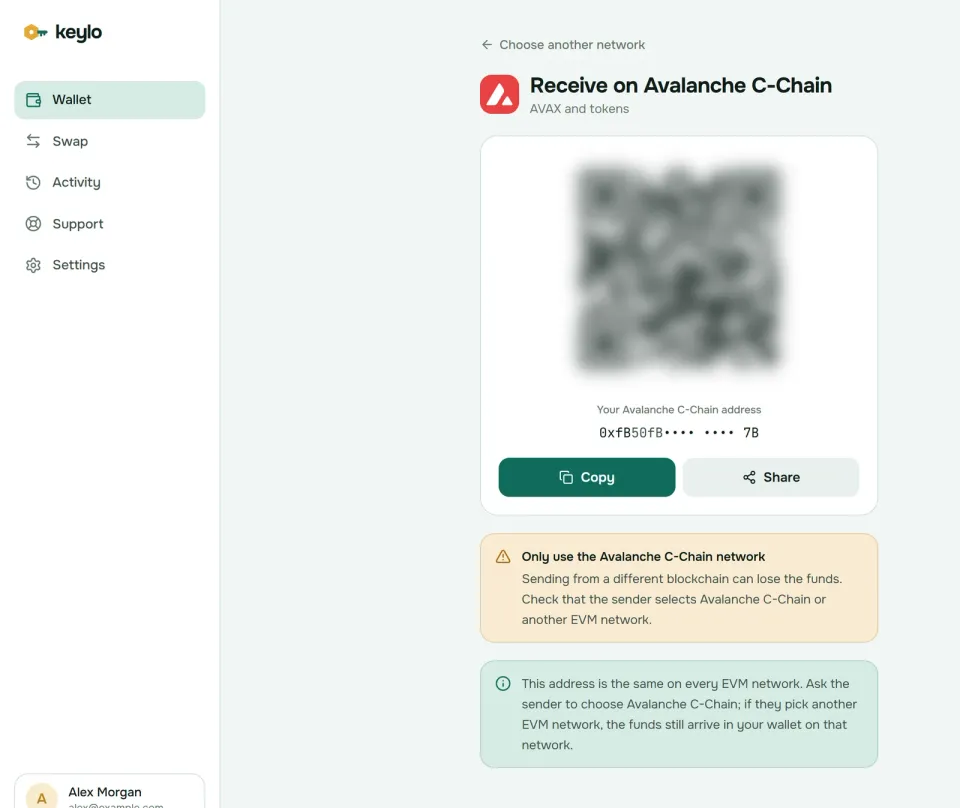
Tap Receive and choose Avalanche C-Chain. The screen reads "Receive on Avalanche C-Chain" with your address and a QR code.
Tap Copy or Share, or show the code to the sender.
On the exchange, pick the network called Avalanche C-Chain or AVAX C-Chain. Never pick X-Chain for this address.
Watch your balance. It updates within seconds of the deposit, and the SnowTrace button beside your address lists the transaction.
Exchanges don't all offer the same Avalanche chains. In its October 2025 update, Avalanche's support page listed Binance, KuCoin and Gate.io with both X-Chain and C-Chain support, Kraken and Crypto.com with C-Chain support, and Coinbase as C-Chain only. Exchanges change this, so check the form each time. Some exchanges also offer wrapped AVAX on other networks, which won't show under Avalanche C-Chain either.
How to send AVAX and tokens on Avalanche#
Tap Send and choose AVAX or a C-Chain token.
Paste or scan the recipient into To. Keylo validates the address and its checksum.
Enter an amount, or tap Max, which leaves enough AVAX for the fee.
Tap Review and choose Slow, Normal or Fast.
Check the network, the recipient (first and last six characters in bold) and the fee in AVAX and dollars.
Tap Send. Your browser signs it, the status moves from "On its way" to "Sent", and a link opens the transaction on SnowTrace.
What Keylo checks before you sign#
Keylo test-runs every C-Chain transfer and refuses one that would fail on chain. It also catches common Avalanche mistakes:
An X-Chain or P-Chain address. Paste
X-avax1...and Keylo says it isn't a valid Avalanche C-Chain address. Send to the C-Chain address instead, or use Core.No AVAX for gas. A token send from an empty wallet shows "You need some AVAX on Avalanche C-Chain to pay the network fee."
A contract recipient. Keylo warns that tokens sent to a contract that doesn't expect them are usually lost.
The token's own contract. Keylo stops sends to a token's contract address.
C-Chain transfers rarely stall, but if one stays pending, the status screen offers Speed up to resend it with a higher fee.
Sending AVAX to MetaMask, Core or an exchange#
MetaMask, Core and a Ledger used with either one all receive C-Chain AVAX at a 0x address. Copy it from that wallet with Avalanche C-Chain selected, then paste it into To. For an exchange such as Binance, open its AVAX deposit page, choose the C-Chain network and copy the 0x address it shows. The same rule applies when you send from MetaMask. If a deposit page offers only an X-avax1 address, don't send C-Chain AVAX to it.
Avalanche network fees explained#
The C-Chain charges fees in AVAX using a base fee that moves with demand plus an optional priority fee. Unlike Ethereum, Avalanche burns both parts, so validators earn from staking rewards, not from fees. The Avalanche fee documentation covers the details.
The fee floor has changed a lot. It was 25 nAVAX until December 2024, then 1 nAVAX, then 1 wei from April 2025. Since the Helicon upgrade on September 22, 2026, validators vote on the minimum base fee, so it can move without another upgrade. In late September they raised it to 5 nAVAX.
On October 24, 2026, the C-Chain base fee sat near 2.5 nAVAX (the Avalanche name for gwei). A plain AVAX transfer uses 21,000 gas, so it cost about 0.00005 AVAX, or $0.0005 with AVAX near $8.80. Token transfers and swaps use more gas but stay well under a cent.
Speed also improved. The Granite upgrade of November 2025 let validators shorten the minimum time between blocks. Blocks that came about every 1.5 seconds in autumn 2025 have arrived roughly once a second since early 2026. Keylo shows Slow, Normal and Fast with their cost, and they rarely differ by much. Keylo adds no fee to normal sends.
USDC, USDT and .e tokens on Avalanche#
Avalanche tokens are ERC-20 contracts. Keylo finds popular ones such as USDC, USDC.e, USDT and EURC on its own. To add another, go to Settings, Networks, Custom tokens, tap Add token and enter its contract address, symbol and decimals.
The .e suffix marks tokens bridged from Ethereum through the Avalanche Bridge. Issuers now mint the main stablecoins directly on the C-Chain, so check the contract:
USDC
0xB97EF9Ef8734C71904D8002F8b6Bc66Dd9c48a6Eis Circle's native USDC.USDC.e
0xA7D7079b0FEaD91F3e65f86E8915Cb59c1a4C664is bridged USDC, with the symbol USDC.e on chain.USDT
0x9702230A8Ea53601f5cD2dc00fDBc13d4dF4A8c7is Tether's native USDT on the C-Chain.
Native and bridged versions both aim for a dollar, but they're separate contracts, and many exchanges accept only the native ones. Swap a .e token to the native version before depositing it.
Swap AVAX and bridge from the C-Chain#
Keylo gets Avalanche quotes from two sources. LI.FI compares C-Chain DEXs and bridges to networks like Ethereum, Arbitrum and Polygon. THORChain swaps native AVAX for native coins on other chains, such as BTC, ETH, DOGE or XRP, with no wrapped tokens involved.
Tap Swap and pick AVAX or a C-Chain token under You pay.
Under You receive, choose the network and token, for example BTC on Bitcoin.
Compare the routes, which show amount, time and fees.
Open the details: every step, every fee, Minimum you receive and Delivered to, your own address on the other chain.
Confirm. A token payment first needs an approval for exactly that amount.
Follow the progress screen until the funds land.
If a THORChain swap can't complete, it refunds AVAX to your C-Chain address minus network fees. LI.FI bridges either deliver or return funds, sometimes as a different token that still reaches your wallet. Default slippage is 0.5%, and any Keylo service fee is its own line in the quote. The swap and bridge overview explains routes and refunds, and the Bitcoin wallet guide covers what to do once BTC arrives.
Staking AVAX and what Keylo doesn't do#
AVAX staking happens on the P-Chain. Avalanche's docs set the minimum at 25 AVAX for delegating to a validator, for at least two weeks, and 2,000 AVAX to run one. Since Helicon, a validator can stake for as little as 48 hours, but the two-week minimum for delegators stayed. Core handles the move from the C-Chain to the P-Chain and the delegation itself.
No staking. Keylo doesn't see the P-Chain and stakes only on Cosmos SDK chains. Liquid staking tokens on the C-Chain, such as sAVAX, are ordinary ERC-20 tokens that you can still hold and send.
No X-Chain or P-Chain. Use Core for cross-chain AVAX moves.
No dapp connections. Keylo has no browser extension and no WalletConnect, so it can't open Avalanche DeFi or gaming sites.
No NFTs, hardware wallets or card purchases. Buy AVAX on an exchange and withdraw it on the C-Chain.
Keylo is non-custodial too. If you lose both the password and the recovery phrase, the wallet can't be recovered by anyone. All supported networks are on the Keylo networks page.
Avalanche scams and mistakes to avoid#
The wrong chain. Sending to an
X-avax1address from a C-Chain wallet, or picking X-Chain on an exchange, is behind many cases of missing AVAX. Match like chain to like chain.Fake Core sites and apps. Search ads, for example, can lead to lookalike download pages. Type core.app yourself, and never enter your phrase on a website.
Bridged-token confusion. USDC.e sent to an exchange that only takes native USDC can turn into a slow support case.
Address poisoning. Scammers send dust from addresses that copy the start and end of yours. Paste from the original source, not from your history.
Fake support. Keylo staff never ask for your phrase or password. Use the Keylo help page, and see the Keylo security overview for two-factor and anti-phishing settings.
Before your first real Avalanche transfer:
Your phrase is on paper and confirmed in Keylo.
You have a little AVAX on the C-Chain for gas.
The exchange network says C-Chain.
The token contract matches what the recipient expects.
A small test went through first.
The same 0x address works elsewhere too. See the Ethereum wallet guide and the Polygon wallet guide.
Hold AVAX on the C-Chain with keys only you control
Keylo encrypts your recovery phrase on your device and never sees it. Send, swap AVAX for native BTC and bridge from one place.
Avalanche wallet FAQ#
What is the best Avalanche wallet?
It depends on which chains you need. Core, from Ava Labs, covers the C-Chain, X-Chain and P-Chain in a browser extension and mobile apps, so it suits staking. MetaMask handles the C-Chain and connects to Avalanche apps, and a Ledger keeps keys offline. To hold, send and swap C-Chain AVAX with nothing to install, Keylo works in any browser.
Which Avalanche chain should I withdraw AVAX to?
The C-Chain, in almost every case. It's where tokens, DeFi and EVM wallets like Keylo and MetaMask live, and its addresses start with 0x. Choose X-Chain only if your wallet gave you an X-avax1 address on purpose. Avalanche's support pages point out that some exchanges handle both chains and some only one, so match the exchange network to the address you paste.
I sent AVAX to the X-Chain. How do I get it to the C-Chain?
The AVAX is safe at your X-Chain address, but Keylo can't show or move it. Import the same recovery phrase into Core, which shows all three chains. Then use its cross-chain transfer, an export followed by an import, to move the AVAX to the C-Chain. After that it appears under Avalanche C-Chain in Keylo.
Is my Avalanche C-Chain address the same as my Ethereum address?
Yes. The C-Chain uses Ethereum's account model, so the same key gives the same 0x address on both and on other EVM networks. Balances stay separate, though. AVAX sent on the C-Chain shows only there. Your X-Chain and P-Chain addresses are different because they use another derivation and start with X-avax1 or P-avax1.
How much is the Avalanche network fee?
Very low. On October 24, 2026, the C-Chain base fee was about 2.5 nAVAX, so a plain AVAX transfer cost roughly 0.00005 AVAX, about $0.0005. Avalanche burns the whole fee, tip included. Since September 22, 2026, validators vote on the minimum base fee, so it can rise or fall. Keylo shows the exact cost of each speed before you sign.
What is the difference between USDC and USDC.e on Avalanche?
Circle issues USDC directly on the C-Chain at 0xB97EF9Ef8734C71904D8002F8b6Bc66Dd9c48a6E. USDC.e is older USDC bridged from Ethereum through the Avalanche Bridge, at a different contract. Both aim to be worth one dollar, but many exchanges credit only native USDC. If you hold USDC.e, swap it to USDC before sending it to an exchange.
How do I stake AVAX and what is the minimum?
Staking runs on the P-Chain. You can delegate from 25 AVAX for at least two weeks, or run a validator with 2,000 AVAX. Core moves AVAX from the C-Chain to the P-Chain and handles delegation. Keylo has no staking for AVAX, though it can hold liquid staking tokens such as sAVAX like any other C-Chain token.
How long does an Avalanche transaction take?
A few seconds at most. C-Chain blocks have arrived roughly once a second since early 2026, after the Granite upgrade, and Avalanche doesn't need extra confirmations: once the network accepts a block, it won't be reversed. Exchanges add their own processing time to withdrawals, which is usually what makes an AVAX transfer feel slow.
Can I swap AVAX for Bitcoin without an exchange?
Yes. Keylo offers THORChain routes that swap native AVAX on the C-Chain for native BTC, delivered to your own Bitcoin address in Keylo. The quote shows every fee, the expected time and the minimum you'll receive before you sign. If the swap can't complete, THORChain refunds the AVAX to your C-Chain address minus network fees.