An Ethereum wallet is the app that keeps the private key for your 0x address. The address holds ETH plus every ERC-20 token you own, such as USDC and USDT, and the key signs each transaction that moves them. Nobody can reverse a confirmed transfer, so most of the skill lies in checking things before you sign.
Three habits cover most of the risk: keep some ETH for gas, pick Ethereum as the network when an exchange asks, and never approve a token for a site you don't trust. Gas is also far cheaper than its reputation. Figures below were checked on October 24, 2026.
Ethereum at a glance#
Item | Ethereum |
|---|---|
Native coin | ETH. Fees are quoted in gwei, one billionth of an ETH |
Address format |
|
Chain ID | 1 |
Consensus | Proof of stake since September 2022 |
Block time | One block every 12 seconds; final after about 13 minutes |
Fee model | EIP-1559: a base fee that gets burned, plus a tip for the validator |
Typical fee | About $0.002 for an ETH transfer and $0.04 for a swap on October 24, 2026 |
Token standards | ERC-20 for tokens, ERC-721 and ERC-1155 for NFTs |
Explorer | Etherscan |
In Keylo | Send, receive, ERC-20 tokens, ENS names, read-only NFT view, speed-up, swap and bridge through LI.FI and THORChain, Sepolia and Hoodi testnets; no staking or dapp connections |
How an Ethereum wallet works#
Your coins never sit inside the app. The network records every balance, and the wallet holds the key that lets you move yours.
How to find your Ethereum wallet address#
An Ethereum wallet address looks like 0x and 40 characters from 0 to 9 and a to f. Some letters appear in capitals. That mix is a checksum, so a wallet can tell when one character was mistyped. Keylo checks it on every address you paste.
Exchanges sometimes call it an "ERC-20 address". It's the same address, and ETH and every token arrive there with no setup. The address never changes, and anyone can look up its balance by pasting it into Etherscan.
Keylo derives the address from your recovery phrase on m/44'/60'/0'/0/0. MetaMask, Rabby and most other EVM wallets use that path for the first account, so one phrase gives the same address in all of them.
One address on every EVM network#
The same key also gives you the same 0x address on Arbitrum, Base, BNB Smart Chain, Polygon and every other EVM network. The balances stay separate, though. ETH on Arbitrum doesn't show under Ethereum, and moving it between the two takes a bridge.
That's why the network you choose matters more than the address. If an exchange sends to your address on Base instead of Ethereum, the funds still reach you. You'll just find them under Base, where you need Base ETH to move them.
How to choose an Ethereum wallet#
Extension and mobile wallets. MetaMask is a browser extension and mobile app, and Rabby is a browser extension built for EVM networks. Both connect to dapps such as Uniswap and Aave, which is their main strength.
Hardware wallets. Ledger and Trezor keep the key on a separate device, which suits savings you rarely touch.
Exchange accounts. The exchange holds the key, so it controls when you can withdraw.
Web wallets. These open in a browser tab with nothing to install. Keylo is one of them.
Whatever you choose, check the Ethereum basics. A good wallet shows the full fee, warns about contract recipients, displays token contract addresses and can speed up a stuck transaction. It should also use the standard path, so your phrase can move to another app later.
Keylo fits people who want to hold ETH and stablecoins, send them, and swap or bridge them to layer 2 networks from one recovery phrase. It's the wrong tool for DeFi apps, NFT trading or staking, because Keylo can't connect to dapps or stake ETH. For those, use an extension wallet next to it.
How to create an Ethereum wallet in Keylo#
There's no app to download. Keylo runs in any current browser, and you can pin it to your home screen.
Open the Keylo registration page. Fill in Full name, Email, Phone number, Password and Confirm password, tick the terms box, then tap Create account.
If you see "Check your inbox", open the link in the email Keylo sent you.
Tap Create a new wallet on the "Set up your wallet" screen. Your browser generates 12 words, derives a key from your password with Argon2id, and seals the words with AES-256-GCM. Only that sealed copy reaches Keylo's server.
Pick Ethereum in your asset list. The page shows your
0xaddress, your ETH balance and its history.Write down the 12 words. In Settings, choose Recovery phrase, type your password, copy the words onto paper, then prove you have them by confirming a few.
In the same menu, switch on Two-factor authentication and pick an Anti-phishing code.
Don't skip step 5. A password reset reopens your account, not the wallet, and only the 12 words can restore it.
Recover or import an Ethereum wallet#
To restore a wallet from MetaMask, Rabby or Trust Wallet, choose Import a recovery phrase and type your 12 or 24 words. Your first account appears with the same address and balances. Extra accounts, such as Account 2, sit on other paths and won't show up, but their funds stay safe in the original app.
Practice on Sepolia or Hoodi#
Under Settings, open Networks and turn on Testnet mode. Keylo adds Ethereum Sepolia and Ethereum Hoodi, where ETH is free and worthless. ENS names work as recipients on Sepolia too, and each testnet links to a faucet. Since testnet addresses match your real one, read the network name before you share it.
Your Ethereum address, ready in a minute
Register with email and a password. Keylo builds the wallet inside your browser, with one 0x address for Ethereum and its layer 2 networks.
How to receive ETH and ERC-20 tokens#
Tap Receive and choose Ethereum. You'll see "Receive on Ethereum", a QR code and "Your Ethereum address".
Tap Copy or Share, or let the sender scan the code.
On an exchange, pick Ethereum as the withdrawal network. Some label it "ERC20" or "ETH". The same choice applies to USDT and USDC.
Watch your activity list. A transfer usually lands in the next block or two, with a link to Etherscan.
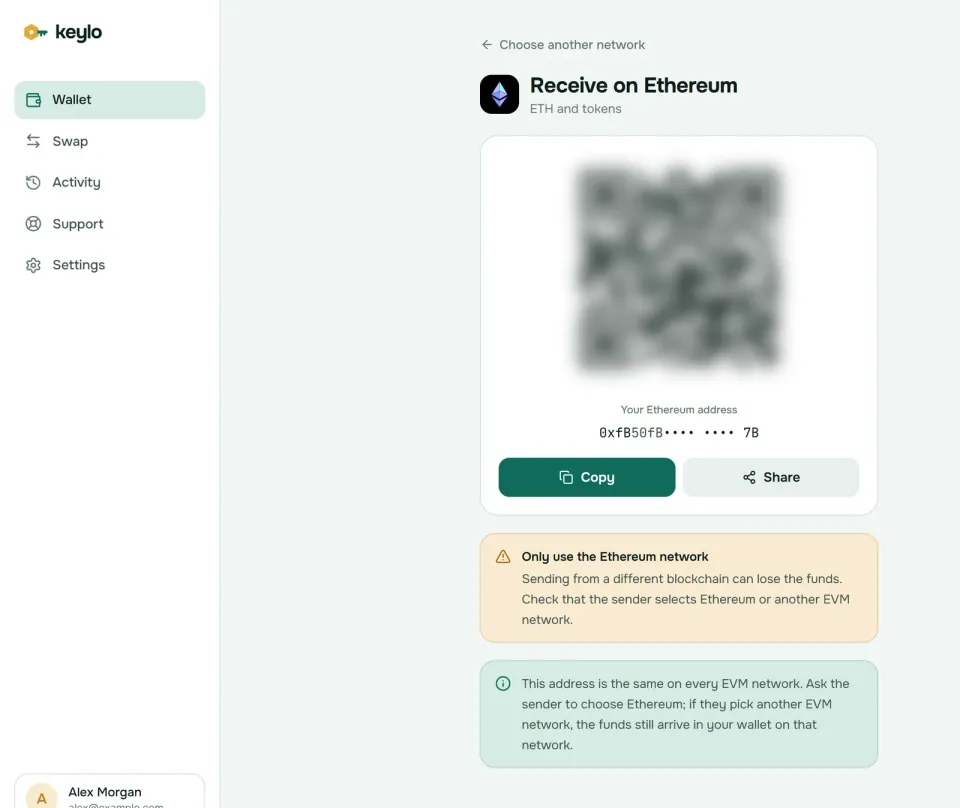
The Receive screen also reminds you that this address works on every EVM network. If a sender picks another network Keylo supports, the money still arrives, just under that network. For a large withdrawal, send a small test first.
How to send Ethereum and tokens#
Tap Send and pick ETH or a token on Ethereum.
In To, paste or scan the recipient's address, or type an ENS name such as
alice.eth.Enter an amount, or tap Max. For ETH, Max holds back enough for the highest fee the transfer could cost, so a tiny remainder may stay behind.
Tap Review and choose Slow, Normal or Fast, each with its cost.
Check the review screen: network, recipient and fee. The first and last six characters of the address are in bold, and an ENS name shows above the address it points to.
Tap Send. Keylo signs in your browser and shows "On its way", then "Sent", with a link to Etherscan.
Sending to an ENS name#
Keylo looks up an ENS name when you tap Review and shows the 0x address it points to. Check that address with the person, because a lookalike name with one letter changed is a known trick.
ENS names work in Keylo only when you send on Ethereum or Sepolia. On other networks, paste the address.
What Keylo checks before you sign#
Keylo test-runs the transfer first, so a send that would fail stops on your screen instead of costing gas. It also warns about these:
A contract as recipient. Tokens sent to a contract that doesn't expect them are usually gone, so Keylo flags it.
The token's own contract. Pasting the USDT contract as the recipient is a classic slip, and Keylo blocks it.
No ETH for gas. A token send with an empty ETH balance shows "You need some ETH on Ethereum to pay the network fee."
An address from another chain. A Bitcoin or Solana address gets a clear message rather than a send.
Ethereum network fees explained#
Wallets call it the network fee, and Ethereum calls it gas: a unit of computing work. A plain ETH transfer uses exactly 21,000 gas. A token transfer uses roughly 45,000 to 65,000, and a swap more. Your fee is the gas used times the gas price.
Base fee and tip#
Since EIP-1559, the price has two parts. The protocol sets a base fee for each block, and the network burns it. It can rise by up to 12.5% after a full block and fall after an empty one. On top, you add a tip for the validator. You also set a maximum, and anything above the real price comes back to you. The ethereum.org gas guide walks through the math.
Keylo's Slow option offers a smaller tip and a lower maximum, while Fast offers a bigger tip and room for the base fee to more than double. Because blocks come every 12 seconds, Slow still usually confirms within a minute or two.
What you pay in October 2026#
Gas is much cheaper than it was. In 2021, prices of 100 gwei or more were common. On October 24, 2026, the Etherscan gas tracker showed about 0.05 gwei, with ETH near $2,360. Part of the reason is capacity: the block gas limit doubled from 30 million to 60 million during 2025.
Action | Gas | Cost on October 24, 2026 |
|---|---|---|
Send ETH | 21,000 | About $0.002 |
Send USDC or USDT | 45,000 to 65,000 | Well under one cent |
Swap on a DEX | Depends on the route | About $0.04 |
Prices can still jump during a busy token launch, because the base fee climbs block after block. Keylo shows the exact fee before you sign and adds nothing to a normal send.
More capacity may follow. The next upgrade, Glamsterdam, adds block-level access lists so nodes can process transactions in parallel. It went live on the Sepolia testnet on October 6, 2026, and in late October its mainnet date was still open. As currently specified, a plain transfer to an existing address stays at 21,000 gas, but one that creates a brand-new account costs more.
When a transaction is stuck#
A transaction stays pending when its fee cap falls below a rising base fee. Tap Speed up on the done screen or in your activity. Keylo resends the same transaction with the same nonce and fees at least 12.5% higher, because nodes ignore a replacement that doesn't pay more. Once the faster copy lands, the original can't.
Tokens, stablecoins and approvals#
Anyone can create an Ethereum token with any name and logo, so the contract address is its only real identity. Keylo checks for well-known tokens and the ones your address holds. If one is missing, add it under Settings, Networks, Custom tokens.
Compare these with the issuer before you accept or swap a stablecoin:
USDC from Circle:
0xA0b86991c6218b36c1d19D4a2e9Eb0cE3606eB48, listed on Circle's contract page.USDT from Tether:
0xdAC17F958D2ee523a2206206994597C13D831ec7.
Both use 6 decimals on Ethereum. A token named USDC at any other address on Ethereum isn't Circle's.
Token approvals#
Before a contract can move one of your tokens, you sign an approval. Approvals stay active until you change them, and some sites ask for an unlimited amount. That's how most drainers work: you approve once on a fake site, and later they take everything.
Keylo's own swap approves exactly the amount you swap, then asks you to confirm the swap itself. Keylo has no approval manager, though. If you granted approvals from another wallet, review and revoke them there, for example with Etherscan's token approval checker.
Swap ETH and bridge to layer 2#
Keylo's Ethereum swaps come from two sources. LI.FI compares decentralized exchanges and bridges, so you can swap ETH for USDC on mainnet or move ETH to Arbitrum, Base or Optimism in one flow. THORChain swaps native ETH for native coins such as BTC, with no wrapped tokens in between.
Tap Swap. Under You pay, pick ETH or a token on Ethereum and enter an amount.
Under You receive, choose the network and token. Search by name, or paste a contract address.
Compare the routes by amount, time and fees.
Open the details for every step, Minimum you receive and Delivered to, which is your own address on the other network.
Confirm, and follow the progress screen until the funds land.
The default slippage is 0.5%. If a THORChain swap can't complete, it refunds the sending address minus network fees. A LI.FI bridge either delivers or sends funds back, sometimes as a different token that still reaches your wallet. Any Keylo service fee sits on its own line in the quote, and the Keylo swap and bridge page explains routes.
Bridging out of mainnet is a common first move, because layer 2 fees are lower still. The Arbitrum wallet guide and the Base wallet guide cover what changes once you're there.
What Keylo doesn't do on Ethereum#
Most Ethereum activity happens in apps, and that's where Keylo stops.
No dapps. Keylo has no browser extension and no WalletConnect, so it can't sign in to Uniswap, Aave, OpenSea or any other site. Its own swap screen handles swaps and bridges.
No staking. Keylo doesn't stake ETH, and running your own validator takes 32 ETH. Liquid staking tokens such as stETH are ordinary ERC-20 tokens, which Keylo can hold and send even though it doesn't stake.
No NFT transfers. Keylo shows your NFTs in a read-only Collectibles section, but it can't send, list or mint them.
No hardware wallets and no card purchases. Buy ETH on an exchange, then withdraw it on Ethereum.
Keylo is also non-custodial: lose both your password and your recovery phrase, and nobody can open the wallet. The list of Keylo networks shows what else the same phrase can hold.
Ethereum wallet scams and how to avoid them#
Almost every Ethereum wallet loss starts with a signature or a pasted address, not a flaw in the chain.
Approval and permit phishing. Fake airdrop and mint sites ask you to approve a token or sign a "permit" message. Since the Pectra upgrade in 2025, some also ask for an EIP-7702 authorization, which hands control of the whole account to their contract. Keylo can't sign requests from websites at all.
Address poisoning. Scammers send zero-value or tiny transfers from addresses that share the first and last characters with ones you use. Copy addresses from the source, never from your history.
Fake tokens and NFTs. Unknown tokens that name a website, or NFTs that promise a reward, lead to drainers. Ignore them.
Fake support. Keylo staff never ask for your recovery phrase or password. Contact the team only through Keylo support, and see how Keylo secures your wallet for two-factor and anti-phishing settings.
Before you move real money, check:
Your 12 words are on paper, and you confirmed them in Keylo.
You hold a little ETH on Ethereum for gas.
The exchange withdrawal network says Ethereum, or ERC20.
The token contract matches the issuer's.
A small test transfer arrived first.
Keep ETH in a wallet only you control
Keylo encrypts your phrase on your own device and never sees it. Send, swap and bridge ETH from one place.
Ethereum wallet FAQ#
What is the best Ethereum wallet for beginners?
It depends on what you'll do. For DeFi apps and NFTs, an extension wallet such as MetaMask or Rabby connects to sites. For savings, add a hardware wallet. To hold, send, swap and bridge ETH and stablecoins with nothing to install, a web wallet like Keylo works.
Is an ERC-20 address the same as my Ethereum address?
Yes. ERC-20 is the token standard on Ethereum, so when an exchange asks for an ERC-20 address it means your normal 0x Ethereum address. ETH, USDT, USDC and other tokens all arrive at it. Just make sure the withdrawal network is Ethereum, because the same address also exists on Arbitrum, Base and other networks.
How much is the Ethereum network fee right now?
Very little as of October 2026. On October 24, the gas price was about 0.05 gwei, so a plain ETH transfer cost around $0.002 and a USDT transfer less than a cent, paid in ETH. Swaps cost more because they use more gas. Fees rise quickly during busy moments, and Keylo always shows the exact cost before you sign.
Are Ethereum wallet addresses case sensitive?
No. The network treats 0xAB... and 0xab... as the same address. The mix of capitals is an EIP-55 checksum that helps wallets catch typos, so an all-lowercase address is valid too. Keylo accepts both, but rejects a mixed-case address whose capitals don't match, because that usually means a mistyped character. Your address also never changes.
How long does an Ethereum transaction take?
Ethereum adds a block every 12 seconds, so a transfer with a normal fee usually confirms within 15 to 30 seconds. Full finality, when a block can't be reverted, takes about 13 minutes. Many exchanges wait for that before crediting a deposit, so allow a little longer there.
Can I use my MetaMask recovery phrase in Keylo?
Yes. Choose Import a recovery phrase and enter the 12 or 24 words. Keylo uses m/44'/60'/0'/0/0, the same path as MetaMask's first account, so you'll see the same address and balances. Extra MetaMask accounts sit on other paths, and accounts you imported with a private key aren't part of the phrase, so neither will appear.
Why is my Ethereum transaction stuck pending?
Usually the base fee rose above the cap you set. Tap Speed up on the done screen or next to the pending transfer in your activity. Keylo resends it with the same nonce and a fee at least 12.5% higher. Once that copy confirms, the original can't, so you never pay twice.
Can I stake ETH from a web wallet?
Not in Keylo, which stakes only on Cosmos SDK chains. To stake ETH, run a validator with 32 ETH or use a staking service. Liquid staking tokens like stETH are normal ERC-20 tokens, and Keylo holds and sends those without staking anything.