A Mantle wallet is any Ethereum-style wallet that can hold MNT and tokens on Mantle Network, an Ethereum layer 2. Your address is the familiar 0x one. The difference is gas: Mantle charges every fee in MNT, not ETH, so a wallet full of ETH or stablecoins can't send a thing until some MNT arrives.
That one rule explains most problems people hit on Mantle, so it comes first here. The other two are picking the right withdrawal network on an exchange and knowing which version of a token you hold. This guide covers all three, plus fees, bridging and Keylo's limits. Figures are as of October 24, 2026.
Mantle at a glance#
Item | Mantle Network |
|---|---|
Gas coin | MNT (18 decimals) |
ETH on Mantle | An ERC-20 token, listed as WETH. It can't pay fees |
Address format |
|
Chain ID | 5000 |
Network type | ZK rollup: OP Stack with validity proofs from OP Succinct, data on Ethereum |
Typical fee | About $0.002 for a token transfer, $0.005 for a swap (October 24, 2026) |
Withdrawal to Ethereum | Within about 12 hours through the official bridge |
Token standard | ERC-20 |
Common tokens | MNT, WETH, mETH, cmETH, USDT0, USDT, USDC, USDe, FBTC |
Explorer | |
In Keylo | Send, receive, popular tokens found automatically (others by contract), Activity for sends made in Keylo, speed-up, swap and bridge through LI.FI, Mantle Sepolia Testnet. No NFT view or dapp connections |
How a Mantle wallet works#
Mantle started life as BitDAO, a large community treasury. In 2023 it became Mantle, and its BIT token turned into MNT, which became the network's gas coin. That history is why Mantle is one of the few big layer 2s that doesn't run on ETH.
Your Mantle wallet address#
Your Mantle wallet address is the same 0x address you use on Ethereum and other EVM networks. In Keylo, all of them share one address, derived on m/44'/60'/0'/0/0. That's MetaMask's path for its first account, so a MetaMask phrase shows the same Mantle balance in Keylo.
There's also no activation deposit, memo or minimum balance. The only thing to watch is that each network keeps its own balances, even at one address.
Two kinds of MNT, and ETH as a token#
On Mantle, MNT is the native coin and ETH is a token. On Ethereum, it's the other way round: ETH pays gas and MNT is an ERC-20 token (0x3c3a81e81dc49A522A592e7622A7E711c06bf354). So "MNT" can mean two different balances at your address, and only the one on Mantle pays Mantle fees.
The same goes for ETH. When you bridge ETH to Mantle, it arrives as a token at 0xdEAddEaDdeadDEadDEADDEAddEADDEAddead1111, shown as WETH. You can hold it, send it and swap it, but it can't cover a fee.
What changed under the hood#
Until September 2025, Mantle settled withdrawals the optimistic way, with a seven-day exit window. Then it switched to ZK validity proofs through OP Succinct, and the exit delay dropped to 12 hours. In April 2026, its Arsia upgrade moved all transaction data onto Ethereum, ending its use of EigenDA. L2BEAT now lists Mantle as a ZK rollup at Stage 0. It notes that a single operator orders transactions and that the contracts can be upgraded instantly.
How to choose a Mantle wallet: extension, app or web wallet#
Any EVM wallet can act as a Mantle wallet, but some make the MNT rule easier to live with.
Extension and mobile wallets. MetaMask (extension and mobile app) and Rabby (browser extension) can add Mantle and connect to its DeFi apps, such as lending markets and DEXs.
Hardware wallets. Trezor lists Mantle among its supported networks. A device like that keeps the key offline, which suits balances you rarely move.
Exchange accounts. Convenient for buying MNT, but the exchange holds the keys.
Web wallets. These open in a browser tab with nothing to install. Keylo is one.
Look for a wallet that already knows Mantle, so you don't paste an RPC address by hand. It should show the fee in MNT and keep MNT back when you send the maximum. Token contract addresses also matter, because several dollar tokens share similar names here.
Keylo is a good fit for holding MNT, mETH and stablecoins, sending them, and swapping or bridging from one phrase. It isn't the tool for Mantle DeFi apps, because it can't connect to dapps.
How to create a Mantle wallet in Keylo#
Mantle is already in Keylo's network list, so there's nothing to add.
Go to Keylo's sign-up form and fill in your name, email, phone number and a password, typed twice. Agree to the terms and press Create account.
If a "Check your inbox" message appears, open the email and confirm.
On "Set up your wallet", press Create a new wallet. Your browser makes a 12-word recovery phrase and encrypts it with your password, using Argon2id and AES-256-GCM. Keylo stores only that locked copy.
Open Mantle in the asset list. Your
0xaddress and MNT balance appear.In Settings, open Recovery phrase, enter your password and copy the 12 words onto paper. Keylo then checks a few of them.
While you're in Settings, add Two-factor authentication and an Anti-phishing code.
Nobody can rebuild the wallet for you, so keep that paper safe. A password reset gets you back into the account, but only your 12 words can restore the wallet itself.
Bringing a wallet from MetaMask#
Press Import a recovery phrase instead, and type your 12 or 24 words. Your first MetaMask account then shows up with its Mantle balance. Extra accounts you added in MetaMask use other paths, so they won't appear, but their funds stay put.
Try it on Mantle Sepolia#
Switch on Testnet mode under Settings, then Networks, and Keylo adds Mantle Sepolia Testnet. Then get free test MNT from a public Mantle Sepolia faucet and practice a few sends before you move real MNT.
Get a Mantle address with MNT gas handled
Sign up with email and a password. Keylo creates your wallet in the browser and holds back MNT for fees whenever you send the maximum.
How to receive MNT and tokens on Mantle#
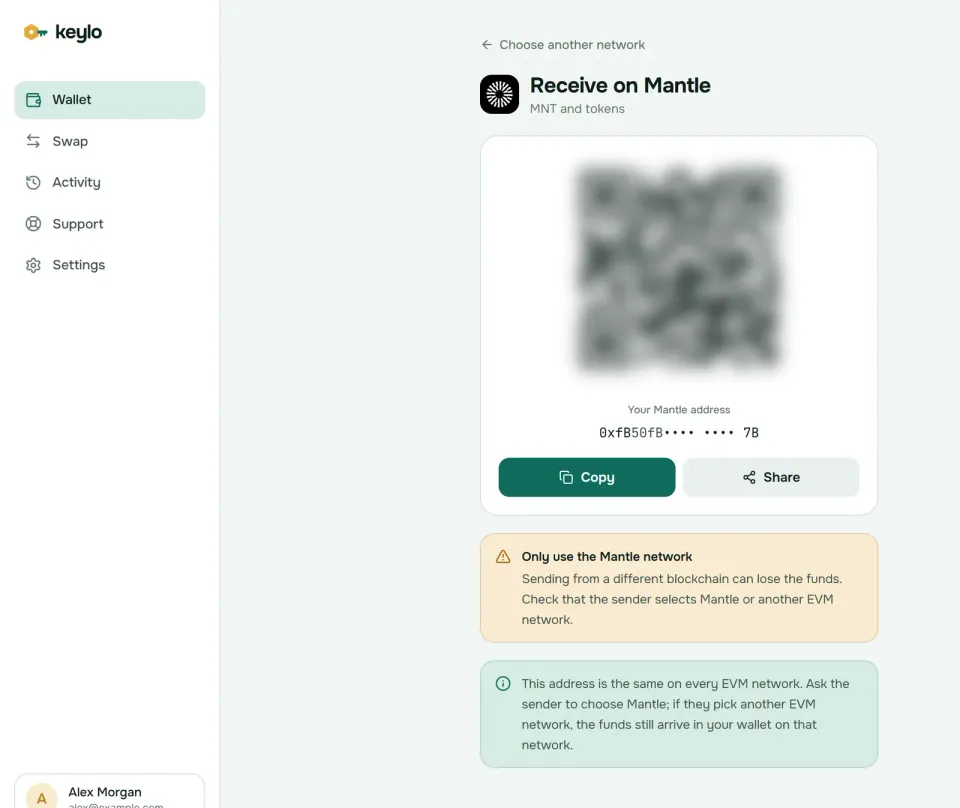
Tap Receive and choose Mantle. The screen reads "Receive on Mantle" and shows your QR code.
Tap Copy or Share, or let the sender scan the code.
When you withdraw from an exchange, choose Mantle as the network, not Ethereum (ERC-20).
Check the balance in Keylo once the exchange marks the withdrawal complete. Mantle itself confirms in a few seconds, but exchanges add their own processing time. The deposit won't appear in Keylo's Activity list, which on Mantle shows only transfers sent from Keylo, so use the link icon next to your address to see it on Mantlescan.
Exchanges often list MNT on both Mantle and Ethereum. Pick Ethereum, and the MNT still reaches your address, but as a token on Ethereum. It shows under Ethereum in Keylo and can't pay Mantle fees until you bridge it. Because the address is shared, nothing is lost, though moving it costs Ethereum gas.
How to send MNT on Mantle#
Tap Send, then choose MNT or a token on Mantle.
In To, paste or scan the address. Keylo checks the checksum and flags contract addresses.
Enter an amount, or tap Max. For MNT, Max leaves enough for the fee.
Tap Review and choose Slow, Normal or Fast.
Look over the network, recipient and fee in MNT, then tap Send.
Watch it go from "On its way" to "Sent". The View on Mantle Explorer link opens the transaction on Mantlescan.
What Keylo catches before you sign#
Keylo runs a quick check before each Mantle transfer, so mistakes show up on the review screen instead of on chain.
No MNT for gas. Try to send USDT0 from a wallet without MNT, and Keylo says you need some MNT on Mantle to pay the network fee.
A contract as recipient. Tokens sent to a contract that doesn't expect them are usually lost, and Keylo warns you.
The token's own contract. Keylo blocks a send to the token's own address.
Sending MNT to an exchange? Check that its deposit page lists the Mantle network for MNT. Some only accept the ERC-20 version on Ethereum.
Mantle gas fees in MNT#
Every Mantle fee has two parts. The execution fee pays for running your transaction on Mantle. The rollup fee pays for posting its data to Ethereum. You pay both in MNT.
Ethereum prices its costs in ETH, so Mantle converts them using an ETH to MNT ratio. The ratio comes from several price oracles, and Mantle limits how fast it can change. That's why your fee in MNT can drift when MNT's price moves, even on a quiet day. Mantle's fee documentation has the formula.
Don't be alarmed by the gas price. On October 24, 2026, Mantlescan showed 50 gwei, which looks steep next to Ethereum. But those are gwei of MNT, a far cheaper coin, so the same tracker put a token transfer at about $0.002 and a swap at $0.005.
The fee on Keylo's review screen includes both parts, and normal sends carry no Keylo fee. Mantle rarely gets congested, so Slow and Fast often cost about the same. If a transfer stalls, Speed up resends it with a higher fee.
mETH, USDT0 and other Mantle tokens#
Mantle tokens are ERC-20s. Keylo checks USDT0, USDT, USDC, USDe, WETH and WBTC on its own. mETH, cmETH and anything else only appear once you add them under Settings, Networks, Custom tokens with Add token, entering the contract, symbol and decimals. Names prove nothing, so match contract addresses:
mETH
0xcDA86A272531e8640cD7F1a92c01839911B90bb0is Mantle's liquid staking token. It gains value against ETH as staking rewards build up.cmETH
0xE6829d9a7eE3040e1276Fa75293Bde931859e8fAis mETH put to work in restaking, with restaking risks on top.USDT0
0x779Ded0c9e1022225f8E0630b35a9b54bE713736is the cross-chain version of Tether's USDT. An older bridged USDT (0x201EBa5CC46D216Ce6DC03F6a759e8E766e956aE) also exists, so check which one a recipient accepts.USDC
0x09Bc4E0D864854c6aFB6eB9A9cdF58aC190D0dF9is bridged from Ethereum. Circle doesn't issue USDC on Mantle as of October 2026.
Getting ETH back out of mETH also takes time. Mantle's mETH docs say unstaking has a 12-hour minimum. Beyond that, the wait depends on how much ETH sits in the protocol's liquidity buffer and, when that runs short, on Ethereum's validator queue, which can take 40 days or more. Restaked cmETH takes up to about seven days. Swapping either for ETH is faster, but you get the market price.
Yield figures on Mantle tokens change daily and are never guaranteed, so treat any fixed promise as a red flag.
Bridging to and from Mantle#
The official Mantle bridge moves MNT, ETH and supported tokens between Ethereum and Mantle. Mantle's docs put deposits at about two minutes and withdrawals within 12 hours. You finish a withdrawal with transactions on Ethereum, paid in ETH. Keylo can't connect to that site, but it has its own route.
Keylo gets bridge and swap quotes from LI.FI, which compares DEXs on Mantle and bridges to other networks. Bridges that pay from their own liquidity usually beat the official bridge's 12 hours, because they don't wait out the exit delay.
Tap Swap. Under You pay, choose the network and token you're starting from.
Under You receive, choose Mantle and a token, ideally MNT for your first trip.
Compare the routes. Each shows the amount, the tool, the time and the fees.
Check Minimum you receive and Delivered to, which is your own Mantle address.
For a token, approve exactly that amount, then confirm.
Follow the transfer on the tracking screen until it lands.
Holding tokens on Mantle but no MNT? You can't swap them for MNT yet, because the swap itself needs MNT for gas. Ask for a small MNT withdrawal on the Mantle network, or bridge in from another network with MNT as the output. A bridge either delivers or returns your funds, sometimes as another token that still reaches your wallet, and any Keylo service fee has its own line. See the swap and bridge page for routes and refunds.
What Keylo doesn't do on Mantle#
No dapp connections. No browser extension and no WalletConnect, so Mantle lending markets, DEXs and points apps are out of reach.
No staking. Keylo can hold and send mETH or cmETH, but it can't stake ETH into mETH or unstake it. Keylo stakes only on Cosmos SDK chains.
No NFTs. There's no NFT view on Mantle, and Keylo can't send NFTs.
No hardware wallets and no card purchases. Buy MNT on an exchange, then withdraw it on the Mantle network.
If you lose both your password and your recovery phrase, nobody can open the wallet, Keylo included. The networks page lists every network Keylo supports.
Mantle scams and mistakes to avoid#
Mantle runs plenty of reward campaigns, so scammers copy them.
Fake reward claims. "Claim your MNT" sites, ads and direct messages lead to drainers. A real campaign never needs your recovery phrase.
Copycat tokens. Other tokens use the MNT and mETH tickers. Compare the contract address with Mantlescan or the issuer's own site.
Approval drainers. A site asks you to approve a token, then empties it. Keylo doesn't sign for websites, and its swaps approve only the amount you swap.
Address poisoning. Tiny transfers arrive from addresses that look like ones you use. Copy addresses from the source, not your history.
The wrong network. MNT withdrawn on Ethereum lands as an ERC-20 there, not as Mantle gas.
Keylo staff never ask for your phrase or password. Get help through the Keylo support page, and read how Keylo secures your wallet. Metis Andromeda is another layer 2 with its own gas coin, covered in the Metis wallet guide. For mainnet, see the Ethereum wallet guide.
Mantle wallet FAQ#
Do I need MNT to pay gas on Mantle?
Yes. MNT is Mantle's only gas coin, and every transaction pays its fee in MNT, whatever token it moves. ETH on Mantle is an ERC-20 token, so it can't pay fees. Keep a few MNT on the Mantle network at all times. If you run out, ask a friend or an exchange for a small MNT withdrawal on Mantle.
Which network should I pick to withdraw MNT from an exchange?
Pick Mantle if you want MNT for gas. Choosing Ethereum (ERC-20) delivers MNT to the same address, but on Ethereum, where it's an ordinary token that can't pay Mantle fees. It isn't lost: you'll see it under Ethereum in Keylo, and you can bridge it across, paying Ethereum gas in ETH for that step.
How long does it take to withdraw from Mantle to Ethereum?
Through the official Mantle bridge, within about 12 hours. Mantle cut the delay from seven days to 12 hours in September 2025, after it moved to ZK validity proofs. You finish on Ethereum with a transaction paid in ETH. Liquidity bridges, like many routes Keylo finds through LI.FI, often deliver in minutes.
Why does Mantle show a gas price of 50 gwei?
Because Mantle prices gas in MNT, not ETH. MNT costs far less than ETH, so the gwei figure looks large while the fee stays tiny. On October 24, 2026, Mantlescan showed 50 gwei, yet put a token transfer at about $0.002 and a swap at about $0.005. Keylo shows the fee in MNT and dollars.
What is the difference between mETH and cmETH?
mETH is Mantle's liquid staking token for ETH. It rises in value against ETH as staking rewards accrue, and unstaking takes at least 12 hours, sometimes weeks. cmETH is a 1:1 receipt for mETH used in restaking, so it adds restaking risk and extra rewards, with an unstake of up to about seven days. Both need MNT to move.
What is the difference between USDT and USDT0 on Mantle?
Both aim to be worth a dollar, but they're different contracts. USDT0 (0x779Ded0c9e1022225f8E0630b35a9b54bE713736) is the cross-chain version of Tether's USDT. The older bridged USDT sits at 0x201EBa5CC46D216Ce6DC03F6a759e8E766e956aE. Before you send either to an exchange, check which one its Mantle deposit page accepts, or swap to the right one first.
Is my Mantle address the same as my Ethereum address?
Yes. Mantle uses Ethereum's account model, so one key gives one 0x address on both networks, and on other EVM networks too. The balances stay separate. MNT on Ethereum and MNT on Mantle are two different balances at the same address, and only the Mantle one can pay Mantle gas.
Is there a Mantle wallet extension?
Any EVM browser extension can work as one. MetaMask and Rabby add Mantle with chain ID 5000 and connect to its lending markets and DEXs. Keylo isn't an extension: it's a web wallet that runs in a browser tab on a computer or phone and can be added to your home screen. It suits holding and sending MNT rather than using Mantle apps.