An Ethereum Classic wallet holds ETC, the coin of the original Ethereum blockchain, and signs the transactions that move it. Your ETC address is a 0x address in exactly the same format as Ethereum's. In Keylo it's even the same string. That's handy, but it also makes it easy to send on the wrong chain or open an address you didn't expect.
Three things matter most. Choose Ethereum Classic, never Ethereum, whenever you send or withdraw. Know which derivation path your old wallet used before you import a phrase. And let a large deposit gather confirmations before you treat it as final. All figures below are as of October 24, 2026.
Ethereum Classic at a glance#
Item | Ethereum Classic |
|---|---|
Native coin | ETC |
Address format |
|
Chain ID | 61, which keeps ETC transactions from being replayed on Ethereum |
Consensus | Proof of work, mined with the Etchash algorithm |
Block time | About 13.5 seconds on average |
Fee model | A single gas price, paid in full to the miner; no base fee or burn |
Typical fee | About 0.000021 ETC for a transfer, well under a cent |
Supply | Block reward cut by 20% every 5 million blocks; capped below 210.7 million ETC |
Explorer | Blockscout |
In Keylo | Send, receive, ETC tokens, history, speed-up, read-only NFT view; no swaps, bridges, staking or testnet |
What makes Ethereum Classic different#
In 2016, after the DAO hack, most of the Ethereum community backed a hard fork that returned the stolen funds. That fork became today's Ethereum. A minority kept running the unchanged chain under the idea that code is law, and it carried on as Ethereum Classic with ETC as its coin.
Since then the two have split further. Ethereum switched to proof of stake in 2022, while Ethereum Classic kept mining. It still runs the EVM, so Ethereum tools and contracts mostly work there, although its app and token scene is much smaller.
ETC also has a fixed emission schedule, set in ECIP-1017. The block reward drops by 20% every 5 million blocks. The latest cut came at block 25,000,000 on July 22, 2026, taking the reward from 2.048 to 1.6384 ETC. Total supply can never pass about 210.7 million ETC.
Mining has a weak spot, too. Attackers gathered enough hash power to rewrite recent ETC blocks in January 2019 and three more times in July and August 2020. That history explains why exchanges still wait for many confirmations on ETC deposits.
Your Ethereum Classic wallet address#
An ETC address starts with 0x and continues with 40 letters and digits, some in capitals. The capitals form a checksum, and Keylo checks it on every address you paste. ETC has no memo, no activation deposit and no minimum balance. To check any ETC address's balance, paste it into the Blockscout explorer.
The same string as your Ethereum address#
Keylo derives your ETC address on m/44'/60'/0'/0/0, Ethereum's standard path. So the address you see under Ethereum Classic matches your Ethereum address exactly. The balances are completely separate, though, because they sit on different chains. Sending ETH there doesn't give you ETC, and the reverse is true too.
Each ETC transaction also carries chain ID 61 in its signature. A transfer you sign for Ethereum Classic can't be replayed on Ethereum, which was a real risk right after the 2016 split.
Coin type 61: why imported balances can look empty#
The Ethereum Classic community's own standard path is m/44'/61'/0'/0/0, with 61 as ETC's coin type. Ledger uses it. The community also warns that Trust Wallet derives ETC differently from MetaMask. MetaMask uses Ethereum's 60 when you add the ETC network, and Keylo does the same.
So the same recovery phrase can show two different ETC addresses depending on the app. Import a phrase from a coin-type-61 wallet into Keylo, and you'll see a new, empty address. Your ETC is still safe at the old one. Open the original wallet and send the ETC to your Keylo address on the Ethereum Classic network. The ETC community's article on derivation paths explains the split.
How to choose an Ethereum Classic wallet#
The ETC community's wallet list covers all the main types.
Mobile wallets. Trust Wallet is the community's suggestion for a simple phone app.
Extension wallets. MetaMask can connect to Ethereum Classic once you add the network, which you need for ETC dapps.
Hardware wallets. Ledger and Trezor are on the list and suit larger amounts.
Web wallets. The list includes MyEtherWallet. Keylo is another web option, with ETC already in its network list.
For ETC in particular, check the derivation path a wallet uses, since it decides which address you'll see. Also look for a fee you can see before you sign and a clear Ethereum Classic label on every screen, because the address alone won't tell you the network.
Keylo suits people who want to hold and send ETC next to the coins on their other networks, under one recovery phrase. It's a weaker fit for trading ETC or using ETC apps, because Keylo has no ETC swaps and can't connect to dapps.
How to create an Ethereum Classic wallet in Keylo#
You need only a browser, on a phone or a computer. Keylo also works from your home screen if you add it there.
Start at the Keylo registration form. Enter your full name, email, phone number and a password twice, agree to the terms, and tap Create account.
If Keylo asks you to check your inbox, follow the link in that email.
Choose Create a new wallet. The browser generates a 12-word phrase on your device, derives a key from your password with Argon2id, and encrypts the phrase with AES-256-GCM. Keylo's servers receive only the encrypted copy.
Open Ethereum Classic from your assets to see your ETC balance and
0xaddress.Record the phrase. Settings has a Recovery phrase option: enter your password, write the 12 words on paper, then confirm a few of them.
Also in Settings, turn on Two-factor authentication and choose an Anti-phishing code.
A forgotten password isn't fatal, but a lost phrase can be. Keylo never learns either one, so after a password reset only the 12 words bring the wallet back.
Importing a phrase you used for ETC#
Choose Import a recovery phrase and enter 12 to 24 words. A MetaMask phrase shows the same ETC address and balance in Keylo, because both use path 60. A phrase from Ledger, Trust Wallet or another wallet that doesn't use path 60 for ETC opens a different, empty address, as explained above. Keylo has no ETC testnet, so start with a small transfer.
An ETC address in about a minute
Sign up with an email and a password. Keylo creates your wallet inside the browser, with Ethereum Classic ready next to every other network.
How to receive ETC#
Tap Receive and pick Ethereum Classic. The screen reads "Receive on Ethereum Classic", with a QR code.
Tap Copy or Share, or let the sender scan it.
On the exchange, choose ETC or Ethereum Classic as the network, never Ethereum.
Watch your activity list. The transfer appears once it's in a block, with a link to Blockscout, where you can watch confirmations grow.
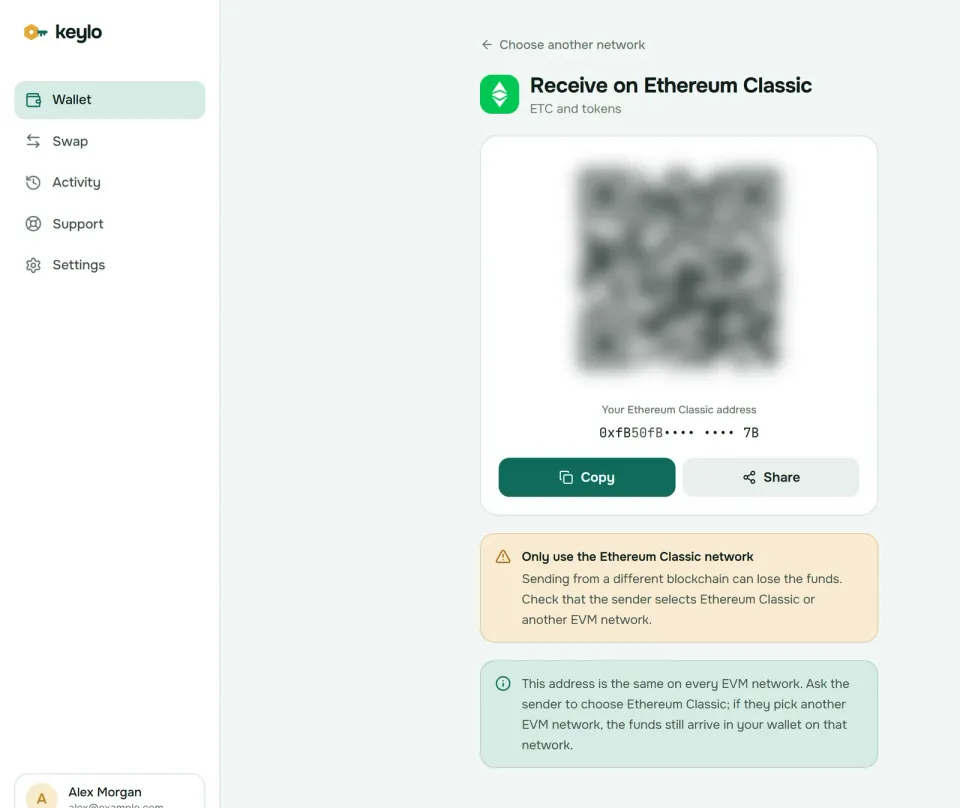
The Receive screen notes that your address is the same on every EVM network. So if someone sends ETH to it on Ethereum by mistake, nothing is lost. You'll find it under Ethereum in Keylo.
For a large payment from someone you don't know, wait for many blocks before you treat it as settled. Every extra block makes a rewrite more expensive, and the explorer shows the count.
How to send ETC#
Tap Send and choose ETC, or a token on Ethereum Classic.
Paste or scan the recipient's address into To.
Enter an amount or tap Max. Max on ETC keeps back enough for the fee.
Tap Review and choose Slow, Normal or Fast.
Check the review screen: the network name, the recipient with its first and last six characters in bold, and the fee in ETC.
Tap Send. Keylo signs in your browser, shows "On its way" and "Sent", and offers a View on Blockscout link.
Keylo simulates each transfer first and stops one that would fail. It warns you when the recipient is a smart contract and blocks sends to a token's own contract. Before you send to an exchange, confirm the deposit page you copied from is the ETC page, since exchanges often show similar 0x addresses for several networks.
Ethereum Classic fees and confirmations#
ETC still uses Ethereum's original fee model. You offer a gas price, and miners pick the best-paying transactions first. The whole fee goes to the miner, with no base fee and no burn. A plain ETC transfer uses 21,000 gas.
On October 24, 2026, the network's suggested gas price was 1 gwei. So a transfer cost 0.000021 ETC, about $0.0002 with ETC near $7.60. Keylo's Slow option offers the network's suggested price, while Normal and Fast add 10% and 30%. Keylo adds nothing of its own.
Several proposals would add an Ethereum-style base fee to ETC, among them ECIP-1111, part of a package called Olympia. As of October 2026 they're drafts with no activation block. If you read this much later, check the ECIP site for changes.
Blocks arrive about every 13.5 seconds, but mining is random, so gaps of a minute happen. Keylo shows a transfer as sent once it's in a block. Exchanges usually wait for far more blocks than other chains need because of the 51% attacks. If a transfer sits pending, Speed up resends it with a higher gas price.
Tokens and stablecoins on Ethereum Classic#
ETC supports ERC-20 tokens at your same address, and each one needs ETC for gas. Keylo picks up tokens your address holds from the network's explorer index. To add one by hand, use Settings, Networks, Custom tokens.
The token scene is small, and names prove nothing. On October 24, 2026, Blockscout listed several tokens on ETC that call themselves USDT or USDC. Neither Tether nor Circle lists Ethereum Classic among its networks, so none of those are the real thing.
One dollar token with a known issuer is Classic USD (USC). Brale issues it, says it's backed by cash and short-dated US government debt, and lists its ETC contract as 0xDE093684c796204224BC081f937aa059D903c52a. Its supply is still small, so check where you could redeem or sell it first.
You'll also see wrapped ETC (WETC), which apps on ETC use. Even WETC exists at several addresses, so check the contract an app points to, and treat any token that appeared uninvited as spam.
How to trade ETC, and what Keylo doesn't do#
Keylo can't swap or bridge ETC, because neither LI.FI nor THORChain supports the network. The usual route is an exchange that lists ETC:
Copy your exchange's ETC deposit address.
Send ETC from Keylo on the Ethereum Classic network.
Trade there, then withdraw the new coin on its own network.
Look for it under that network in Keylo.
The swap and bridge page shows which networks have in-wallet routes. ETC also has its own decentralized exchanges, but you'd need a wallet that connects to apps.
Keylo's other limits on ETC:
No dapp connections. There's no browser extension and no WalletConnect.
No NFT transfers. Keylo shows ETC NFTs in a read-only Collectibles view, but it can't send them.
No mining, staking or hardware wallets, and no card purchases.
Keylo is also non-custodial. If you lose both your password and your recovery phrase, nobody can open the wallet, Keylo included. See the full list of Keylo networks for what else the phrase covers.
Ethereum Classic scams and mistakes to avoid#
Picking Ethereum by mistake. It's the most common ETC error. Check the network name on both the exchange and the Keylo screen.
Importing and panicking. An empty balance after an import usually means a different derivation path, not theft. Don't hand your phrase to anyone who offers to "find" the coins.
Fake stablecoins and airdrops. Tokens named USDT or USDC on ETC are fakes, and airdropped tokens that link to a website lead to drainers.
Address poisoning. Scammers send tiny transfers from lookalike addresses. Copy addresses from the source, never from your history.
Impersonators. Keylo staff never ask for your recovery phrase or password. Reach them through Keylo's support page, and read how Keylo keeps wallets safe.
A last check before you move real ETC:
The 12 words are on paper and confirmed in Keylo.
The network reads Ethereum Classic, on both sides.
The deposit address came from the exchange's ETC page.
A small test arrived before the full amount.
Your Keylo address also works on Ethereum itself, covered in the Ethereum wallet guide. For another proof-of-work coin, see the Bitcoin wallet guide.
Hold ETC in a wallet only you control
Keylo encrypts your recovery phrase on your own device and never sees it. Keep ETC next to your other coins.
Ethereum Classic wallet FAQ#
What is the best Ethereum Classic wallet?
It depends on how you hold ETC. For large amounts, a hardware wallet such as Ledger or Trezor is safest. For ETC apps, MetaMask connected to Ethereum Classic works. To hold and send ETC next to other coins without installing anything, a web wallet like Keylo fits. Check each wallet's derivation path before you move a phrase between them.
Is my ETC address the same as my ETH address?
In Keylo and MetaMask, yes, because both derive ETC on Ethereum's path, coin type 60. The balances are separate, since the two are different chains. Wallets that use ETC's own coin type 61, such as Ledger, give a different ETC address from the same phrase. Always choose the network explicitly, because the address alone doesn't say which chain you mean.
Can I use MetaMask as an ETC wallet?
Yes. Add Ethereum Classic as a custom network with chain ID 61, currency ETC and a public ETC RPC address. MetaMask then shows ETC on the same address as your ETH, because it derives both on coin type 60. Keylo works the same way, so importing that MetaMask phrase into Keylo shows the same ETC address and balance.
I sent ETC to my ETH address. Is it lost?
Usually not, if the address is yours. The ETC sits at that same address on Ethereum Classic. Wallets that use path 60, such as MetaMask and Keylo, show it once you open the ETC network. If the address belongs to an exchange, only the exchange can help, so send its support the transaction hash. Never share your phrase for a "recovery".
Why does my ETC show zero after I imported my phrase?
Your old wallet probably used coin type 61, ETC's standard path, while Keylo uses Ethereum's path 60. The same phrase then produces two different addresses, and Keylo shows the empty one. Your ETC is still at the original address. Open the old wallet and send the coins to your Keylo address on the Ethereum Classic network.
How many confirmations does an ETC deposit need?
There's no single number. Keylo shows a transfer as sent once a block includes it. Because ETC suffered 51% attacks in 2019 and 2020, exchanges usually wait for many more blocks than on Bitcoin or Ethereum before crediting a deposit. Their deposit pages state their own rule. For a large private payment, wait well past the first few blocks yourself.
Is Ethereum Classic still proof of work?
Yes. Ethereum moved to proof of stake in 2022, but Ethereum Classic kept mining with the Etchash algorithm. Miners collect the block reward, 1.6384 ETC since the reduction at block 25,000,000 on July 22, 2026, plus every transaction fee. The reward falls by another 20% every 5 million blocks.
How much does it cost to send ETC?
Almost nothing as of October 2026. With the network's suggested gas price at 1 gwei, a plain transfer used 0.000021 ETC, about $0.0002. Token transfers use more gas but stay far below a cent. Keylo shows the exact fee in ETC before you sign and adds no fee of its own to normal sends.
Is there a stablecoin on Ethereum Classic?
Yes, a small one. Classic USD (USC), issued by Brale, runs on ETC at contract 0xDE093684c796204224BC081f937aa059D903c52a. Tether and Circle don't list Ethereum Classic, so tokens there named USDT or USDC aren't theirs. Check a stablecoin's contract on Blockscout, and confirm who will redeem it, before you accept one as payment.
How do I trade ETC for another coin?
Keylo has no ETC swaps or bridges, since its routing partners don't support the network. Send ETC from Keylo to an exchange's ETC deposit address, trade there, then withdraw the new coin to Keylo on that coin's own network. ETC has decentralized exchanges too, but they need a wallet that connects to apps.